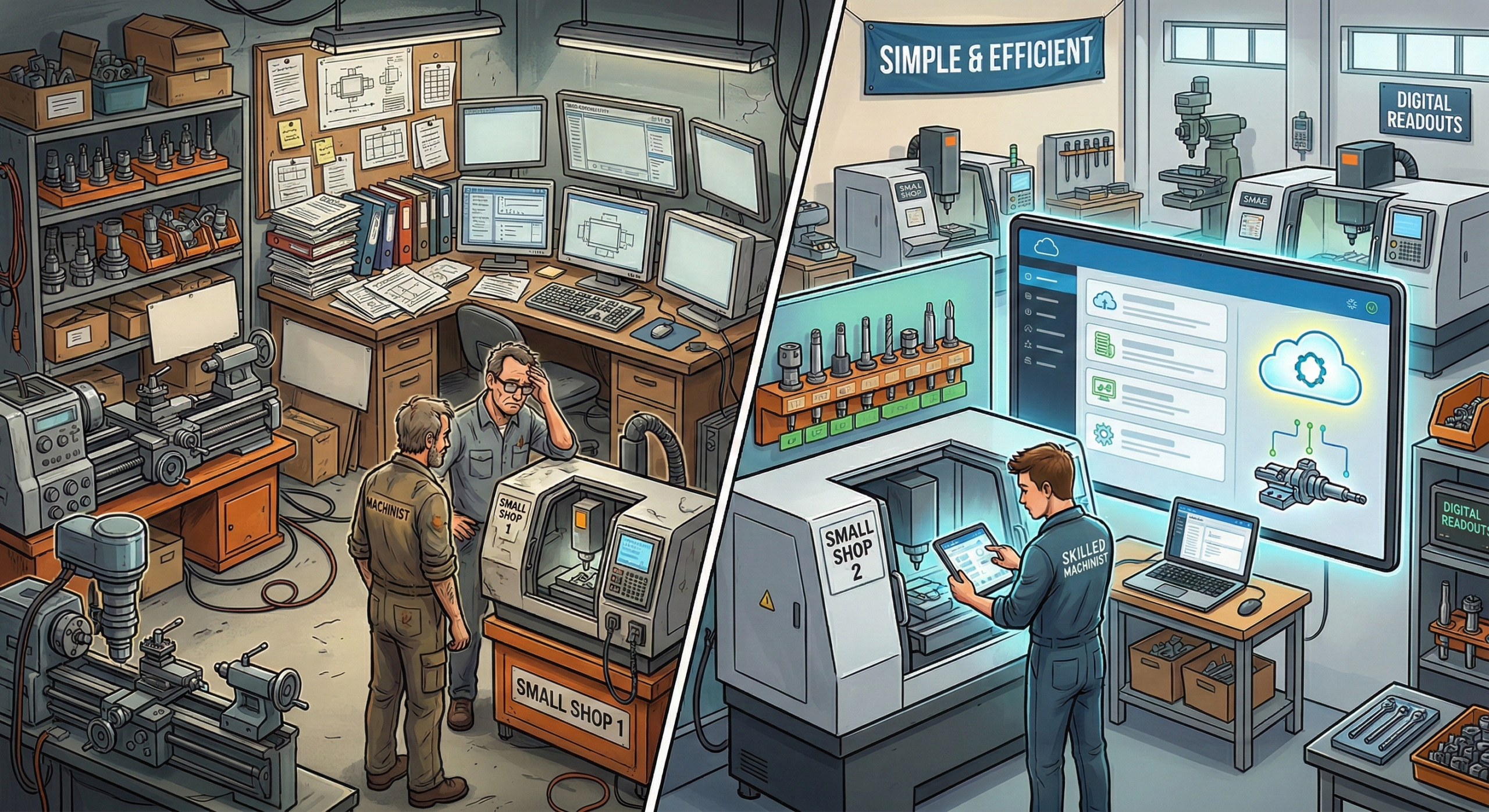
Large-scale enterprises often rely on robust Tool Management Systems (TMS) to keep their spindles turning. However, for the smaller shop, these “solutions” often create more problems than they solve.
The Barriers to Entry: Why Traditional Systems Fail Small Shops
The transition from a manual “whiteboard and memory” system to a digital one is fraught with challenges that are unique to smaller operations:
Prohibitive Complexity: Most traditional TMS are designed for massive facilities. They are packed with features like advanced inventory forecasting, automated procurement, and intricate tool-life algorithms. For a shop with ten machines, this is often “overkill,” requiring a steep learning curve for a staff that is already stretched thin.
High Upfront Costs and Maintenance: Beyond the initial licensing fees, traditional software often requires dedicated hardware (servers), implementation consultants, and ongoing maintenance contracts. For a lean business, the Return on Investment (ROI) can take years to realize.
Limited Human Resources: In a small shop, the “Tool Manager” is usually also the programmer, the setup tech, and sometimes the owner. Finding the 40+ hours required to manually input tool geometries and manufacturer data into a complex system is often impossible.
The Shift Toward Simplified, Cloud-Based Solutions
To bridge this gap, a new category of “lightweight” digital tool management has emerged. These solutions prioritize digital continuity—the seamless flow of data from the tool manufacturer to the CAM software—without the heavy infrastructure of a traditional TMS.
A great fit for a small shop is a platform that offers:
Cloud-Based Infrastructure: No servers to maintain and lower entry costs.
Manufacturer Integration: The ability to download pre-verified tool data directly, saving hundreds of hours of manual entry.
CAM Interoperability: A way to “export” tool assemblies directly into software like Mastercam, Fusion 360, or GibbsCAM.
Example Solution: MachiningCloud
One prominent example of this approach is MachiningCloud. Rather than forcing a shop to adopt an enterprise-level inventory system, it acts as a digital bridge.
Simplicity: It focuses on the most painful part of the process: finding the right tool and getting its dimensions into the CAM system accurately.
Accessibility: Because it’s cloud-based, a shop can start using it immediately without a massive IT project.
Accuracy: By providing direct access to digital catalogs from major tooling brands, it ensures the 3D models and cutting parameters are correct the first time, reducing crashes and “air-cutting” during setups.
Conclusion: Digital Progress is Scalable
Small machine shops don’t need the most expensive software on the market; they need the most effective software for their specific scale. By moving away from complex, localized systems and toward agile, data-centric platforms, small shops can finally eliminate the “tooling bottleneck” and focus on what they do best: cutting metal.